


YOKOHAMA Forever Forest Activities
This is an initiative to create our own forests using native tree species at our domestic and international locations, contributing to nature-positive goals.
Scope of the Activity
"YOKOHAMA Forever Forest" commenced in 2007 as a project to make good use of potential natural vegetation and plant 500,000 saplings at sites related to production and sales in Japan and abroad by 2017, the 100th anniversary of Yokohama Rubber.
Starting with tree planting at the Hiratsuka Factory on November 11 in 2007, the project was carried out at sites in Japan and overseas and the goal of planting 500,000 saplings was achieved in September 2017.
Making good use of the knowledge we have cultivated, we will continue to work on this initiative by providing saplings and know-how on tree planting as well as actually planting trees at our factories and other locations, with the aim of continuing to contribute to the conservation of regional biodiversity.
By the end of 2024, we had planted 826,000 trees and provided 574,000 saplings at 14 sites in Japan and 22 sites in eight foreign countries, making a total of 1,400,000 trees that had been planted.
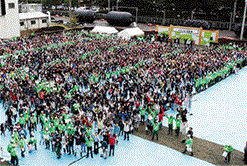
First tree-planting ceremony at Hiratsuka Factory in November 2007
The Progression of the YOKOHAMA Forever Forest Activity

Click names of plants to see activities progress at each plant.
Click here for activity progress at all factories.


Japan
Head Office / Hiratsuka Factory(HQ / HP) Mishima Plant (SP) Shinshiro Plant (TP) Shinshiro-Minami Plant Mie Plant (MP) Onomichi Plant (OP) Nagano Plant (GP) Ibaraki Plant (IP) Yokohama Tire Retread Company Limited Nagoya Plant Yokohama Tire Retread Company Limited (YTR) D-PARC Yokohama Mold Co., Ltd. (YMC)North America, Latin America
Yokohama Tire Manufacturing Mississippi, LLC.(YTMM) Yokohama Tire Manufacturing Virginia, LLC (YTMV) YOKOHAMA TIRE CORPORATION Corporate Headquarters & Western RDC Yokohama Industries Americas Inc. (YIA) Yokohama Industries Americas Ohio Inc.(YIA-OH) Yokohama Industries Americas South Carolina LLC(YIA-SC)Asia
Europe
Purpose of Forever Forest Activity
Developing participants' environmental awareness
Participants in this project do everything on their own, from germinating saplings to tree-planting, and even to the nurturing of forests. The "realization" that participants gained by actually joining the activity help develop their environmental awareness.
Disaster prevention, and the formulation of environmental conservation forest
Since the broad-leaved evergreen trees selected for planting are less likely to be blown down by typhoons and also fire-resistant, they minimize damage from disasters such as earthquakes, typhoons, tsunamis, and fires, and their forests can also serve as evacuation areas for local residents. The know-how cultivated through Yokohama Forever Forest Activity has been utilized in the project of building the "forest seawall" (tree-planting for the “Heisei no Mori” in Otsuchi Town), tsunami countermeasures beginning in 2012.
Contribution to decelerating global warming
The forests created at our Company’s production sites around the world planted with locally-indigenous trees absorb and fix CO2, contributing to curbing global warming
Conservation of biodiversity
Some of the forests at our sites created in the Forever Forest Activity have more than 50 varieties of locally-indigenous tree species, and such forests themselves contribute to biodiversity conservation. These forests also create habitats for birds and insects, fostering rich biodiversity.

Tree planting at Yokohama Tire Manufacturing (Thailand) Co., Ltd.(YTMT)
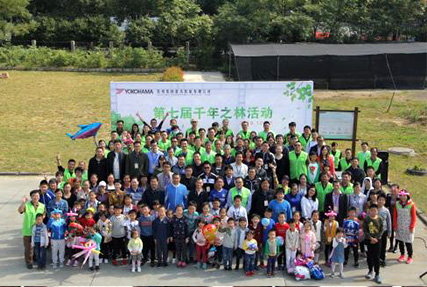
The 7th " Forever Forest" tree-planting ceremony at Suzhou Yokohama Tire Co., Ltd. (CSZY)
Features of Forever Forest Activity
Miyawaki method
Yokohama Rubber has been conducting tree-planting activities under the guidance of the late Akira Miyawaki, a plant ecologist and professor emeritus at Yokohama National University, who has been involved in forestation around the world. The "Miyazaki method" advocated by the late Prof. Miyazaki is different from ordinary afforestation in that it is a distinctive technique in which tree species and different types of saplings that are locally indigenous are grown and planted close together (mixed and dense planting) in arrangements closely resembling natural forests. This method has been employed both inside and outside of Japan to regenerate forests in many different places. It is said that it normally takes 100 years or longer to regenerate a forest; however, the Miyawaki method can regenerate a forest within 10 to 20 years, and after three years from planting, basically, it will become unnecessary to take care of the forest.
In addition, most of the tree species selected in this method are broad-leaved evergreen trees with deep and tap roots that do not easily fall down, creating a strong disaster-prevention forest protecting the environment around it from typhoons, earthquakes, tsunamis, fires, etc. Yokohama Rubber aims for harmonious coexistence with local communities by planting trees around factories of its production sites based on the Miyazaki method for the creation of "YOKOHAMA Forever Forest" having a role to play in minimizing damage in the event of disasters inside or outside of the factories.
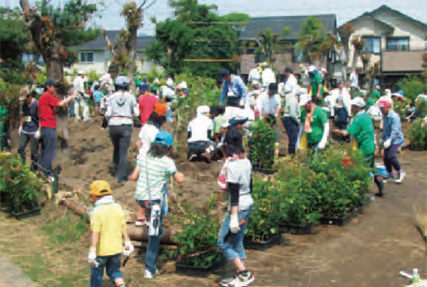
Tree planting using the Miyawaki method at the Shinshiro Plant
Raising saplings by hand
This initiative, starting with soil preparation and progressing through acorn collection and seedling production, is largely carried out by employees. By the end of fiscal year 2024, the proportion of self-produced seedlings reached 70%. Each factory systematically cultivates seedlings through acorn collection, sowing, and seedling production, aiming to plant them at their own facilities and contribute to local communities by providing seedlings.
Tree planting by employees and local residents
This project being done at our sites around the world is supported by the efforts of employees, their families, and local residents who plant trees and take care of them after that. We hope that planting and nurturing trees together will create a sense of unity between our employees and people in local communities, contributing to an increase in trust from people within those communities. We also encourage people at municipal administrative agencies to take part in our project in order to secure further support for the tree-planting activity in each local community.
Measuring Effect of Tree Planting
Monitoring of the amount of CO2 absorbed and fixed and bird-watching are being conducted at the Hiratsuka Factory. Trees absorb CO2 in the atmosphere and fix it onto cell walls, etc. It is known that the amount of CO2 absorbed and fixed by a tree can be estimated by measuring the diameter of its tree trunk and height. The amount of CO2 stored by the trees has been monitored by measuring their diameter and height on a regular basis since April 2009.
The total amount of CO2 absorbed and fixed by Yokohama Rubber's entire Forever Forest was estimated based on the results of the most recent growth survey (growth and survival rates of the planted trees) conducted in the Hiratsuka Factory.
The estimated result indicates that the trees of Yokohama Rubber's Forever Forest had absorbed and fixed a total of approximately 2,112 tons of CO2 by the end of 2024.
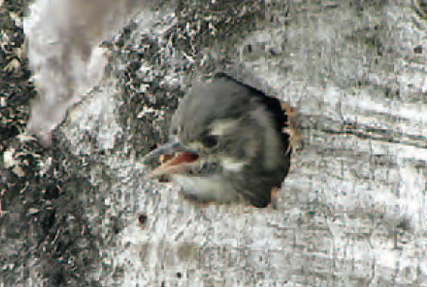
Additionally, the "bird-watching club" consisting of employees voluntarily gathered together takes the initiative in conducting bird-watching once a month from the standpoint of conservation of biodiversity under the guidance of members of "Komatan," the club holding bird-watching parties in Hiratsuka City and Oiso Town. Currently, with the number of wild bird species flying to the forest increasing to 61 as of the end of 2024 (12 species in September 2008, when they started bird-watching, and 55 species as of the end of 2017), employees and local people are continuing bird-watching while having fun.
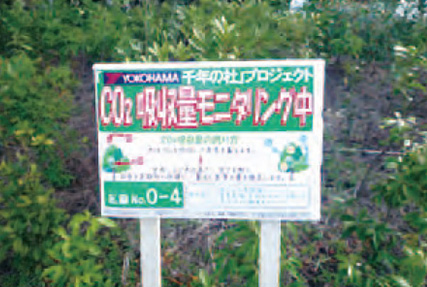
Monitoring of CO₂ absorption
Bird watching
Carbon assimilation in Forever Forest Activities

- By adding the latest tree growth measurement data from the Hiratsuka Plant, we have recalibrated the approximation curve used to estimate the company-wide CO2 absorption and fixation volume.
Therefore, values for past fiscal years may show slight variations from the previous year's estimates.
Sapling donation
We provide the saplings we have nurtured not only to our own factories for tree planting but also to a wide range of organizations including municipalities, schools, and other companies for free. In addition to providing saplings, we also teach elementary school students how to plant trees. The graph below shows the progress state of the Forever Forest project that has expanded within and outside our Company.
The tree planted in the Heisei no Mori, Otsuchi Town, some of which were purchased, are included.

YOKOHAMA Forever Forest Activity in Numbers
825,564
The number of trees planted at our production and sales-related sites as part of YOKOHAMA Forever Forest tree plantings by the end of 2024.
73,635
The number of people who had participated in tree-planting events by the end of 2024.
90
The number of different species of saplings that are planted at sites in Japan. Since saplings are selected to match the environment of the land at each site, different species of saplings are planted depending on the site, with some of which having as many as 68 species of nursery trees. YOKOHAMA Forever Forest Activity are characterized by the combination of tall trees such as Castanopsis sieboldii, Machilus thunbergii and Quercus (Japanese oak) and short trees.
36
The total number of sites in which tree planting had been conducted by the end of 2024.
61
The number of different bird species that have been observed at the Hiratsuka Factory by the end of 2024.
574,100
The total number of saplings provided for external organizations by the end of 2024.
