


G :Governance
Corporate Governance
Sustainability Management
Sustainability Management Promotion Framework
Important Issues of the Yokohama Rubber Group
Enforcement of Environmental Training and Education
Environmental Accounting
Sustainability Management Promotion Framework
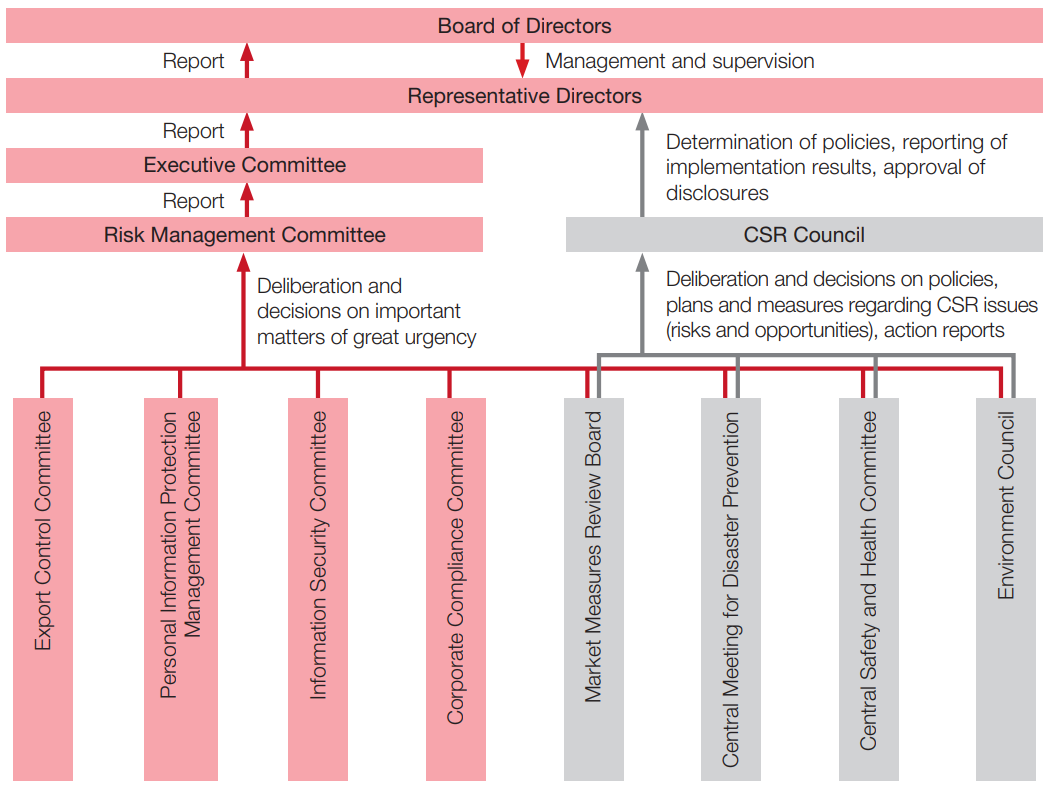
The CSR Council, chaired by our Chairman & CEO and membered by all of the internal directors (including Audit and Supervisory Committee members), meets twice a year (in May and November) to discuss sustainability issues (environment, occupational health and safety, disaster prevention, quality, human capital, human rights, and social contribution, etc.) and plan actions to be taken by the Yokohama Rubber Group.
In addition, in the case that it is necessary to make decisions
on important matters or make early decisions, or make reports or conduct deliberations, an Executive Committee will make reports and conduct deliberations, and submit the details of such reports and deliberations to the Board of Directors according to their importance.
For individual sustainability issues, we have established bodies such as the Environment Council, the Central Safety and Health Committee, and the Central Meeting for Disaster Prevention to formulate and implement more detailed plans and measures.
Progress on sustainability issues is reported monthly to the Chairman & CEO, President & COO, members of the board in charge of CSR Division, and internal directors serving as Audit and Supervisory Committee members.
In addition, at biannual meetings where all Group executives, including those overseas, gather to discuss business strategies and other matters, initiatives on carbon neutrality and the circular economy are discussed as ongoing themes. For serious and urgent sustainability issues, we respond in cooperation with the “Risk Management Committee.”
In addition, with the aim of implementing high quality and homogeneous sustainability management at all of our bases around the world, we are promoting area management of internal controls, including the environment and compliance, under the control of the regional management company.
In fiscal year 2024, we completed the implementation of the “Global Whistleblowing System” in Indonesia.
In addition, in the case that it is necessary to make decisions
on important matters or make early decisions, or make reports or conduct deliberations, an Executive Committee will make reports and conduct deliberations, and submit the details of such reports and deliberations to the Board of Directors according to their importance.
For individual sustainability issues, we have established bodies such as the Environment Council, the Central Safety and Health Committee, and the Central Meeting for Disaster Prevention to formulate and implement more detailed plans and measures.
Progress on sustainability issues is reported monthly to the Chairman & CEO, President & COO, members of the board in charge of CSR Division, and internal directors serving as Audit and Supervisory Committee members.
In addition, at biannual meetings where all Group executives, including those overseas, gather to discuss business strategies and other matters, initiatives on carbon neutrality and the circular economy are discussed as ongoing themes. For serious and urgent sustainability issues, we respond in cooperation with the “Risk Management Committee.”
In addition, with the aim of implementing high quality and homogeneous sustainability management at all of our bases around the world, we are promoting area management of internal controls, including the environment and compliance, under the control of the regional management company.
In fiscal year 2024, we completed the implementation of the “Global Whistleblowing System” in Indonesia.
Sustainability Governance and Sustainability Promotion System
Sustainability Management and Area Management

Important Issues of
the Yokohama Rubber Group
In order to build a trusted identity as a contributing member of the global community, Yokohama Rubber Group acts in accordance with the Yokohama Rubber Group Action Guidelines together with its stakeholders, which include customers, shareholders and investors, business partners and suppliers, and employees.
To this end, the Yokohama Rubber Group has specified the following critical issues in reference to benchmarks including the GRI Guidelines and ISO26000, and conducts activities in response as the "Critical Issues of the Yokohama Rubber Group”.
To this end, the Yokohama Rubber Group has specified the following critical issues in reference to benchmarks including the GRI Guidelines and ISO26000, and conducts activities in response as the "Critical Issues of the Yokohama Rubber Group”.
Guided by our fundamental philosophy of "Contributing to happiness and prosperity through product creation with heart and technology," the Yokohama Rubber Group will continue to move forward with our stakeholders by executing the strategies outlined in our medium-term management plan, YX2026. In doing so, we will create and provide the following values to society, based on our code of conduct.
For more information about the YX2026 Medium-Term Management Plan, please visit our corporate website under the “Investor Relations” section.
For information on our sustainability initiatives, please visit “Yokohama Rubber’s Sustainability”.
For information on our sustainability initiatives, please visit “Yokohama Rubber’s Sustainability”.
Enforcement of
Environmental Training and Education
CSR and Environmental Training
We have incorporated CSR and environmental training as one of the subjects to be studied by recent graduate hires and mid-career hires. In addition, a career development course, "CSR and Environmental Knowledge," was held for employees in their second to third year of employment in personnel training for career-track positions.
In addition to learning about the environment in general, education on biodiversity conservation including a river monitoring experience was provided.
In fiscal year 2024, training sessions were primarily conducted in person, with some online participation offered in the second half of the year to accommodate employees working in remote locations. A total of 69 employees participated in these sessions across both semesters.
Additionally, we offered a "CSR (Intermediate Level)" career development course for employees with approximately 10 years of experience. This online course covered topics such as SDGs, ESG investing, and CSR challenges related to the environment, safety and health, disaster preparedness, and business continuity planning (BCP). 67 employees participated in this course. These career development courses are mandatory for promotion.
To date, 1,064 employees have participated in CSR training, representing 19% of Yokohama Rubber's workforce.
In addition, in order to ensure that our managerial and supervisor level employees thoroughly understand ISO14001, we are conducting training classes for environmental internal auditors.
Including 70 personnel who have completed this course to get certified in fiscal 2024, currently a total of 2,741 personnel have been registered and are already active as our internal auditors. (47.6% are qualified internal auditors in the scope of the integrated certification.)
In addition to learning about the environment in general, education on biodiversity conservation including a river monitoring experience was provided.
In fiscal year 2024, training sessions were primarily conducted in person, with some online participation offered in the second half of the year to accommodate employees working in remote locations. A total of 69 employees participated in these sessions across both semesters.
Additionally, we offered a "CSR (Intermediate Level)" career development course for employees with approximately 10 years of experience. This online course covered topics such as SDGs, ESG investing, and CSR challenges related to the environment, safety and health, disaster preparedness, and business continuity planning (BCP). 67 employees participated in this course. These career development courses are mandatory for promotion.
To date, 1,064 employees have participated in CSR training, representing 19% of Yokohama Rubber's workforce.
In addition, in order to ensure that our managerial and supervisor level employees thoroughly understand ISO14001, we are conducting training classes for environmental internal auditors.
Including 70 personnel who have completed this course to get certified in fiscal 2024, currently a total of 2,741 personnel have been registered and are already active as our internal auditors. (47.6% are qualified internal auditors in the scope of the integrated certification.)
Enhancement of Education Activities
As part of our environmental education activities, we conduct improvement activities by getting involved with all our personnel by sending our President’s message to all our employees in the Energy Saving Month in February and the Environment Month in June every year. For our Environment Month from June 1 to 30, we accept suggestions for environmental month slogans and posters from all Yokohama Rubber Group employees and family members up to elementary school student age.
In fiscal year 2024, we received 5,533 eco-declarations and 123 posters from domestic participants, while international participants submitted 4,831 eco-declarations and 749 posters.
In fiscal year 2024, we received 5,533 eco-declarations and 123 posters from domestic participants, while international participants submitted 4,831 eco-declarations and 749 posters.
| Japan | Overseas | |
|---|---|---|
| Environmental Slogan Excellent Works | 20 | 22 |
| Poster Excellent Works | 9 | 26 |
In addition, the best works were selected for both Japan and overseas.
Environmental Slogan Best Work
“Treat every day as Environment Month! Don't leave lights on or water running!! And don't let others do it either!!”
Shinshiro Plant, Manufacturing Section 2, Vulcanization Yuta Harada
Shinshiro Plant, Manufacturing Section 2, Vulcanization Yuta Harada
“Today, pick up trash and plant trees- the next day, life will be fresh and green”
YTVI QAS Tran Thanh Viet
YTVI QAS Tran Thanh Viet
<Environmental Poster Best Work>

Mie Plant, Manufacturing Section 1, LT Cutting Yusuke Hata

YMTC QA &QC Dept. Benjawan Sadsri
President’s Award for Environmental Contribution
The Environmental Activity Awards were newly established in FY2022 with the aim of improving environmental management throughout the Group.
Starting in fiscal year 2024, the award categories have been changed to the “Environmental Risk Management Award,” “Sustainability Promotion Award,” and “Special Award.”
All divisions of the Yokohama Rubber Group are eligible for the awards, which are selected after reviewing and deliberating the activities conducted during the year for each case study in each field. Each award-winning division will receive an award from the General Manager of the CSR Division.
Starting in fiscal year 2024, the award categories have been changed to the “Environmental Risk Management Award,” “Sustainability Promotion Award,” and “Special Award.”
All divisions of the Yokohama Rubber Group are eligible for the awards, which are selected after reviewing and deliberating the activities conducted during the year for each case study in each field. Each award-winning division will receive an award from the General Manager of the CSR Division.
Environmental Accounting
Environmental conservation costs
Calculated since fiscal 2013 with the Head Office and domestic production bases as a boundary in reference to the environmental accounting guidelines issued by the Ministry of the Environment.
- (Millions of yen)
Move the screen to the left or right to see the table information
| Item | Major initiatives | FY 2023 | FY 2024 | |||
|---|---|---|---|---|---|---|
| Business area costs | Investments | Costs | Investments | Costs | ||
| Pollution prevention costs | Installation of deodorization equipment, supporting CFC regulations, etc. | 525 | 99 | 241 | 163 | |
| Global environmental conservation costs | Compressors, air conditioning renewal, adoption of hybrid forklifts, etc. | 124 | 478 | 160 | 551 | |
| Resource recycling costs | Costs related to waste segregation and processing | 0 | 556 | 0 | 579 | |
| Subtotal | 649 | 1,133 | 401 | 1,294 | ||
| Upstream and downstream costs | Expenses for reuse of tire bladders and plastics liners for rubber take-up | 0 | 67 | 0 | 66 | |
| Management activity costs | EMS maintenance, management, and information disclosure costs | 0 | 161 | 0 | 154 | |
| Research and development costs | Research and development costs for reducing the environmental burden | 228 | 914 | 86 | 876 | |
| Social activity costs | Tree planting activities in areas affected by the Great East Japan Earthquake, social contribution activities, etc. | 0 | 32 | 0 | 227 | |
| Environmental remediation costs | Reserves for PCB processing, etc. | 0 | 31 | 0 | 271 | |
| Subtotal | 877 | 2,388 | 487 | 2,888 | ||
| Total | 3,214 | 3,375 | ||||
Economic effect
- (Millions of yen)
Move the screen to the left or right to see the table information
| Type of effect | Major initiatives | FY 2023 | FY 2024 |
|---|---|---|---|
| Profits | Profits gained from wastes and recycling from business activities | 58 | 52 |
| Cost reduction | Cost reductions through energy conservation | 206 | 233 |
| Cost reductions through the use of recycled products | 868 | 952 | |
| Total | 1,132 | 1,237 |
Environmental conservation effects
Move the screen to the left or right to see the table information
| Year-on-year reduction | ||
|---|---|---|
| Type of effect | FY 2023 | FY 2024 |
| Greenhouse gas emissions (thousand tons, CO2) | 2,712.4 | -6,179.7 |
| VOCs emissions (tons) | -4.0 | 82.5 |
| Waste reclamation quantity (tons) | Zero emissions achieved domestically in FY 2010 | |
| Waste emissions (tons) | -105.7 | -287.8 |
Environmental efficiency
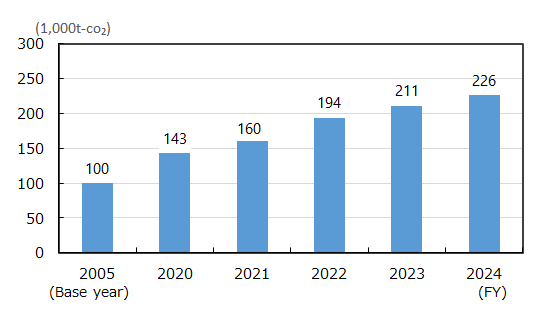
Greenhouse gas indicator
Index of sales/greenhouse gas emissions, with a value of 100 for the base year (FY 2005)
Index of sales/greenhouse gas emissions, with a value of 100 for the base year (FY 2005)
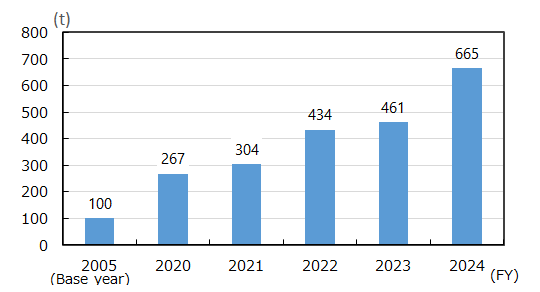
VOCs indicator
Index of sales/VOC emissions, with a value of 100 for the base year (FY 2005)
Index of sales/VOC emissions, with a value of 100 for the base year (FY 2005)
Industrial waste emission indicator
Index of sales/industrial waste emissions, with a value of 100 for the base year (FY 2005)
Index of sales/industrial waste emissions, with a value of 100 for the base year (FY 2005)

