



YOKOHAMA's Technology
Yokohama Rubber's Marine Hoses Support Global Energy Transportation Through Reliability and Technology
MB
Petroleum resources are indispensable to our lives. As a key element in their stable transportation, Yokohama Rubber’s marine hoses play the role of “arteries” in harsh offshore environments. By leveraging proprietary rubber-compounding technologies and structural design expertise developed over many years, these hoses have gained a leading share of the global market. They have also earned tremendous trust from major global oil companies that demand extremely strict safety standards.
Marine Hoses: Conduits for Transporting Crude Oil and Petroleum Products
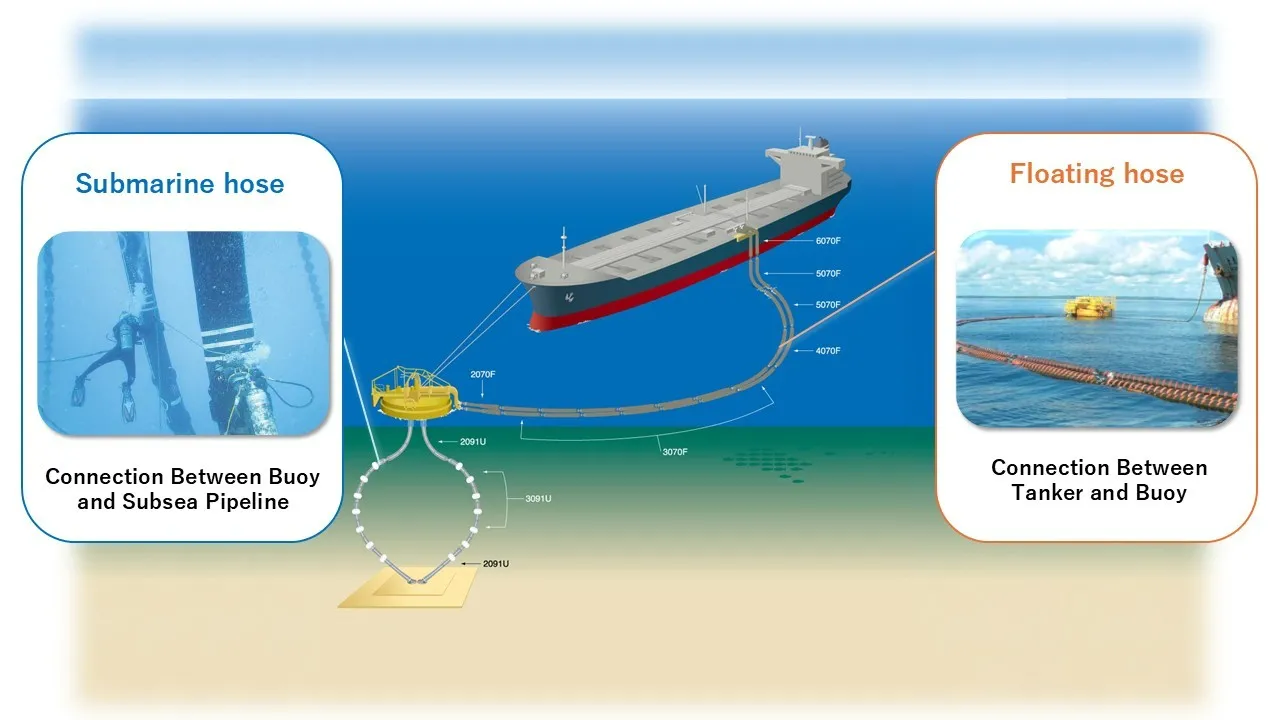
Large oil tankers with capacities of 300,000 to 500,000 tons are often unable to berth directly at ports due to their immense size. Instead, they conduct loading and unloading operations while moored to offshore transfer points (buoys) located away from the shore. Marine hoses serve as the conduits connecting these buoys and tankers, enabling the transportation of crude oil and petroleum products. Crude oil and petroleum products are transferred from tankers to buoys through marine hoses, then transported via subsea pipelines to storage tanks onshore. These hoses are continuously exposed to external forces such as rough waves, ocean currents, and strong winds, and any damage could result in a catastrophic accident such as an offshore oil spill. Because of this, they must be exceptionally durable.
Outstanding Reliability Proven Through Testing That Exceeds International Standards
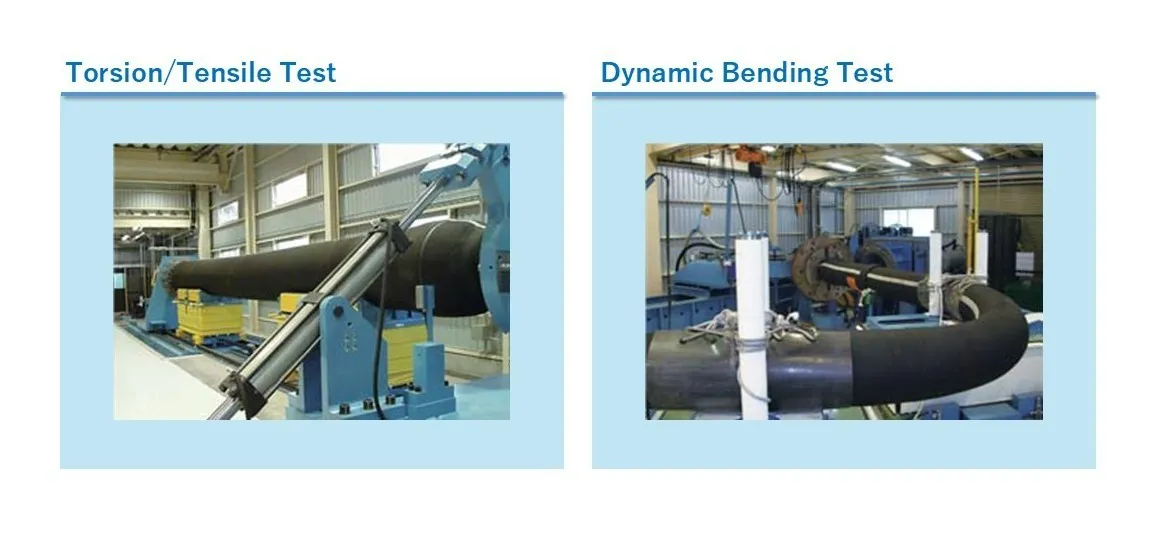
On account of these requirements, international standards for marine hoses have continued to evolve alongside growing awareness of the need to prevent marine pollution. Under the current guideline that came into effect in 2009 (GMPHOM 2009), manufacturers are required to conduct dynamic durability testing on prototype hoses. This type of testing simulates actual operating conditions by subjecting hoses to tens of thousands of cycles of bending, torsion, and tensile loading. Yokohama Rubber's marine hoses have been shown to maintain pressure resistance comparable to that of new hoses even after undergoing tens of thousands of load cycles in this demanding testing. Particularly noteworthy is the company's proprietary evaluation method. While some manufacturers conduct bending tests by allowing hoses to bend naturally under their own weight, Yokohama Rubber employs a more rigorous horizontal bending test, in which loads are forcibly applied through metal fittings. This rigorous pursuit of performance limits beyond international standards supports the proven quality that has made Yokohama Rubber's marine hoses a trusted choice in offshore environments where not a single drop of leakage can be tolerated.
Visual Monitoring System for Reliable Anomaly Detection
To enable early detection of underwater anomalies, Yokohama Rubber equips its marine hoses with uniquely engineered oil leakage detection features. One such feature is the Oil Pot Detector, which responds to pressure changes in the event of a leak. When the first layer of a multi-layer hose is damaged, an increase in internal pressure causes the indicator window of the detector to change color from white to red. This allows for rapid and reliable detection of anomalies, ensuring that no oil leak goes unnoticed, regardless of the type of oil. In addition, the submarine hose connecting the seabed to the offshore buoy is equipped not only with the Oil Pot Detector but also with a Twist Warning System (TWS). This system converts internal hose damage into a visible external change in the form of hose twisting. By enabling divers and operators to intuitively detect anomalies through visual inspection alone, this dual monitoring system significantly contributes to the prevention of oil leaks.

Commitment to Next-Generation Transport Safety
Yokohama Rubber continues to pursue development aimed at achieving more precise maintenance management systems, moving beyond improvements in the performance of individual products by leveraging vast amounts of accumulated data and simulation technologies. In addition to the evaluation methods and anomaly detection systems described above, we are developing new maintenance frameworks that incorporate new technologies such as communication-based management systems and data-driven quantification of product fatigue. Through these initiatives, Yokohama Rubber remains committed to contributing to energy transport safety and marine environmental protection.
