



YOKOHAMA's Technology
Virtual Tire Development Using Numerical SimulationDigitally Visualizing Physical Phenomena Occurring Within Tires and Their Surrounding Environment
Basic Technology
When a tire is in motion, a wide range of physical phenomena occur both within the tire and in its surrounding environment. At Yokohama Rubber, numerical simulations are used to digitally visualize phenomena such as tire deformation and airflow around the tire. Here we introduce our virtual development initiatives, which enable a deeper understanding of these complex physical phenomena to improve development efficiency, realize new performance capabilities, and support the growing adoption of model-based development (MBD) in the automotive industry.
Understanding Complex Physical Phenomena: The Key to Improving Tire Performance
While a tire is in motion, it is continuously subjected to various forces, including friction with the road surface and changing loads. To improve the fuel efficiency, energy efficiency, quietness, and safety required of all types of vehicles, it is essential to understand in detail the tire’s internal deformation and the mechanisms behind the physical phenomena that affect these performance characteristics. However, there are limitations to ascertaining the behavior of a rotating tire through physical testing alone. Conventional development methods, which rely on repeated cycles of prototyping and evaluation, have posed challenges in terms of the time and resources required for development.
Visualizing Physical Phenomena Through Numerical Simulation in a Digital Environment
Yokohama Rubber utilizes numerical simulation to divide into separate computational elements the rubber and reinforcing materials that make up a tire as well as the surrounding air space and to calculate phenomena such as deformation, heat generation, and airflow. This enables physical phenomena related to tire performance to be visualized in a computer-based environment, allowing for more detailed analysis of their underlying mechanisms.
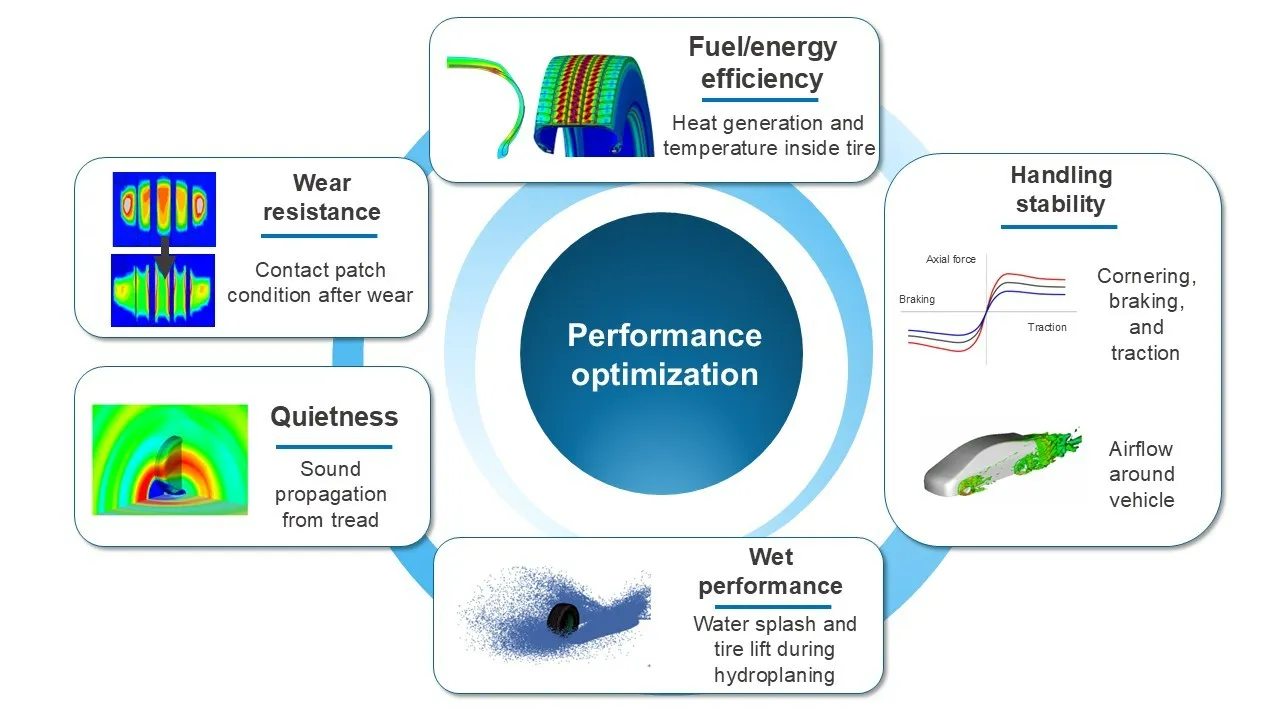
- Handling stability: Simulation is used to evaluate tire dynamic performance such as cornering, braking, and traction, and to promote its application in automotive model-based development (MBD). It is also applied to analyze the influence of airflow disturbances around rotating tires on vehicle behavior and is utilized in the development of aerodynamic technologies that improve overall driving performance.
- Fuel/energy efficiency: Analysis of deformation and heat distribution within the tire during operation is conducted. By identifying sources of energy loss, the analysis is used to study tire shapes and structures that improve fuel and energy efficiency.
- Quietness: The sound frequencies and vibration transmission when the tire comes in contact with the road are digitally reproduced. This enables identification of noise sources and supports tread pattern design that reduces tire noise and enhances in-cabin comfort.
- Wear resistance: Factors such as contact pressure and slip when the tire is pressed against the road are simulated. The results are used to reduce causes of wear and optimize tire shape design for longer service life.
- Wet performance: Water evacuation between the tire and road surface under rainy conditions is digitally reproduced. Factors such as hydroplaning when a tire hits a film of water are analyzed to support tread pattern (groove geometry) design that ensures reliable braking performance on wet roads.
Among these items, tire performance aspects such as fuel/energy efficiency, braking and cornering on dry and wet roads, and ride comfort can sometimes be difficult to achieve simultaneously. However, quantifying each of these phenomena has made it possible to more smoothly achieve “optimization” that balances competing performance requirements based on simulation results.
The Wide-Ranging Benefits of Virtual Development
By understanding the mechanisms through simulation, it becomes possible to predict performance in a computer-based environment. This not only improves tire performance but also reduces the number of physical prototype tires and testing processes required. As a result, it leads to shorter development cycles and more efficient use of resources. Going forward, Yokohama Rubber will continue to pursue virtual development and flexibly respond to the new design methods and performance requirements demanded by next-generation mobility.

