



YOKOHAMA's Technology
Development of Ultra-Large Tires for Mining MachineryYokohama Rubber’s New Approach Settles Trade-off Between Heat and Wear Resistance
Tires
In the mines that support the basic needs of human life through the extraction of underground resources, dump trucks as large as buildings are used to transport massive amounts of minerals in a single trip. The biggest class of dump trucks is capable of carrying loads as heavy as 250 tons, with each tire bearing up to 63 tons. Because of the technical difficulties involved, there are only a few manufacturers in the world that are capable of producing these ultra-large tires measuring 57 inches or more. In 2019, Yokohama Rubber succeeded in developing ultra-large tires based on a revolutionary new approach and began selling them in 2024.

Ultra-Large Tires for Mining Machinery Face Conflicting Requirements
The three key aspects of the performance required of ultra-large tires for mining machinery are durability to withstand heavy loads, heat resistance to endure the heat generated during high-speed and long-distance travel, and wear resistance, which is directly linked to operating costs. Among these, heat and wear resistance are directly at odds with each other because while increasing the amount of rubber in the tread improves wear resistance, it also causes heat resistance to decline. As a result, achieving a balance between these two performance elements has become the most important issue for tiremakers to address when developing ultra-large tires. Since wear resistance is ultimately determined by the amount of rubber in the tire, the challenge lies in how to increase it while at the same time improving heat resistance. Ultra-large tires in particular tend to experience a high degree of deformation due to the heavy loads they carry, which also causes heat generation. To address this issue, Yokohama Rubber had to fundamentally change the way it thought about tire performance and review every aspect of ultra-large tires, from internal structure to tread pattern.

A New Approach Toward Balancing Performance Needs
The approach that Yokohama Rubber came up with was to “control the areas of the tire where the load is applied.” We focused on the sheer size of ultra-large tires, which can reach 3.5 meters in diameter, and developed them in a completely different way from passenger car tires.
For example, passenger car tires generate heat across the entire tire, but since ultra-large mining machinery tires are so huge, Yokohama Rubber studied how to control the specific areas where heat would be generated in order to improve their heat resistance. The idea was to concentrate the heat in areas where a certain degree of accumulation would not matter while suppressing heat generation in places where too much heat would cause problems.
Under this new concept, the first step was to establish target heat resistance levels for each area of the tread. Since heat generation increases when the contact pressure between the tire and the ground is high and decreases when it is low, we calculated the contact pressure distribution needed to meet the targets and thoroughly analyzed how each structural element of the tire would affect the contact pressure. Prototyping is extremely expensive and time-consuming for ultra-large tires in particular, so we utilized simulations based on the Finite Element Method (FEM), through which calculations are made by dividing structures into small parts and quantifying the properties of these parts. By doing so, we determined that tread deformation during inflation, for example, could be controlled through a combination of carcass structure shape and belt structure angle and width.
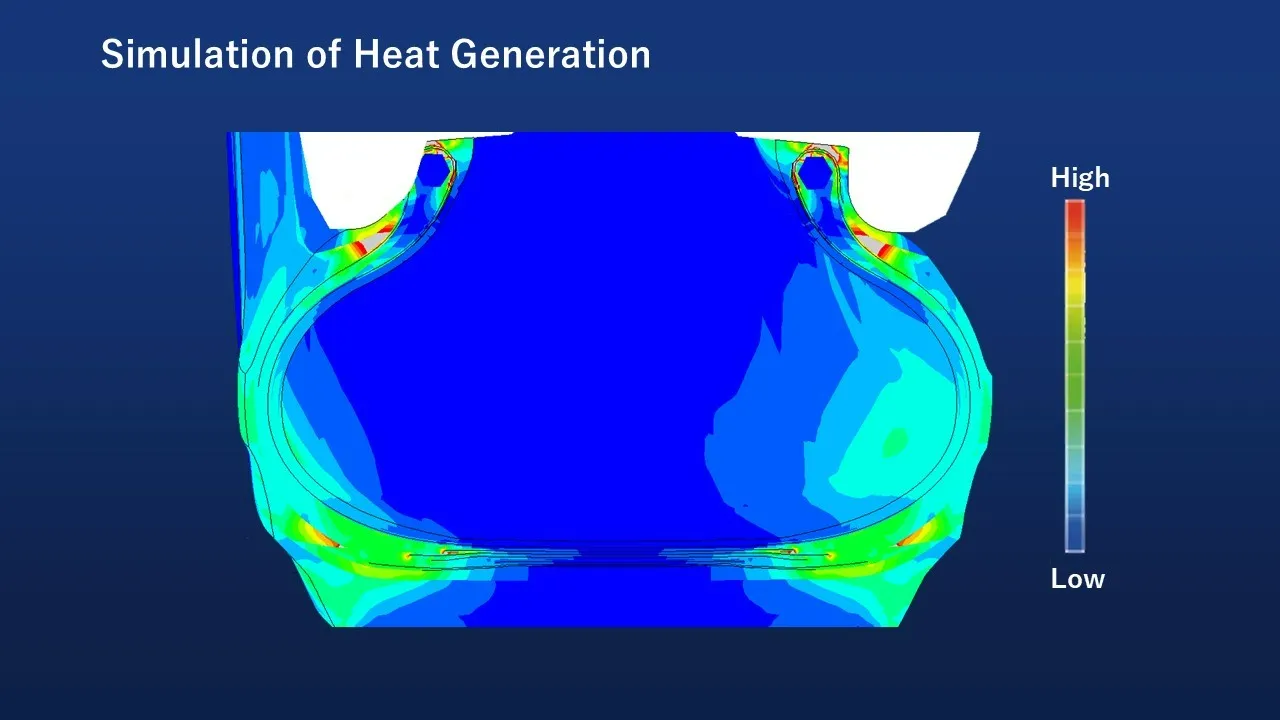
Based on these findings, each structure was designed to achieve the target contact pressure distribution. In addition, a new tread pattern was developed for this unprecedented distribution arrangement, optimizing rigidity while positioning the grooves to maximize air-cooling effects and further improve heat resistance. As a result, the heat resistance was improved without reducing the amount of rubber in the tire and a previously unattainable level of balance between heat and wear resistance was achieved.
By continuing to develop new technologies and products based on the new perspectives and insights gained from this development, Yokohama Rubber aims to support the extraction of resources in mines that are essential to people’s lives.
